Short wave visible channels
When using satellite products that contain short-wave visible channels, it can sometimes be easier to see certain phenomena or features better at high latitudes, due to the longer optical path. For example thin cirrus clouds, dust and smoke are more easily visible at high latitudes because the scattering from the aerosols within a thin layer of ice crystals or a sparse cloud of smoke or dust is stronger than for shorter optical paths.
Figure 20 illustrates how thin cirrus clouds are better visible in GEO satellite images in comparison to polar satellite images. This is due to the light taking a longer path through the atmosphere containing such clouds to the GEO satellites. The difference can best be seen by comparing the images in the Day Microphysics RGB product between the SEVIRI and VIIRS instruments. In the SEVIRI image the cloud can be clearly seen over Swedish and Finnish Lapland (the northern parts of these countries) whereas from VIIRS the signal is very weak. In fact, in VIIRS it is possible to mistake the cloud signal for something else, such as terrain features.
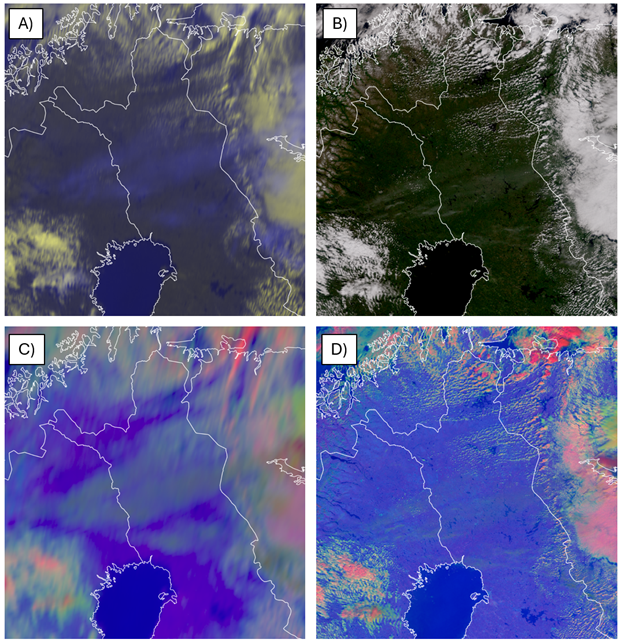
Figure 20: Comparison of cirrus clouds over Finnish Lapland, 27 June 2024 for different satellite products: A) SEVIRI HRV Clouds RGB, 10:15 UTC B) VIIRS True Color RGB, 10:16 UTC C) SEVIRI Day Microphysics RGB, 10:15 UTC and D) VIIRS Day Microphysics RGB, 10:16 UTC.