1. Identify the moisture pattern of an AR
The first step in identifying ARs consists of looking for long and narrow bands of moisture with a column integrated liquid water content of more than 20 mm. For this, you can use satellite imagery and/or NWP diagnostic or forecast fields.
- ARs are moisture bands that are at least 2000 km long and less than 300 km wide
- They have a total column water equivalent of more than 20 mm
They can be best seen in microwave channels from polar orbiting satellites or in the Total Column Water (TCW) parameter from NWP models.
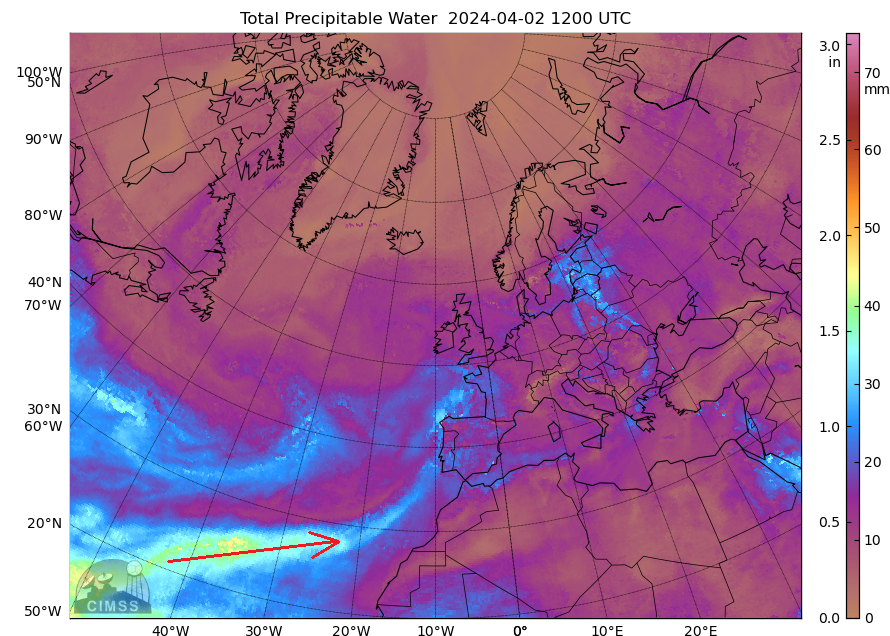
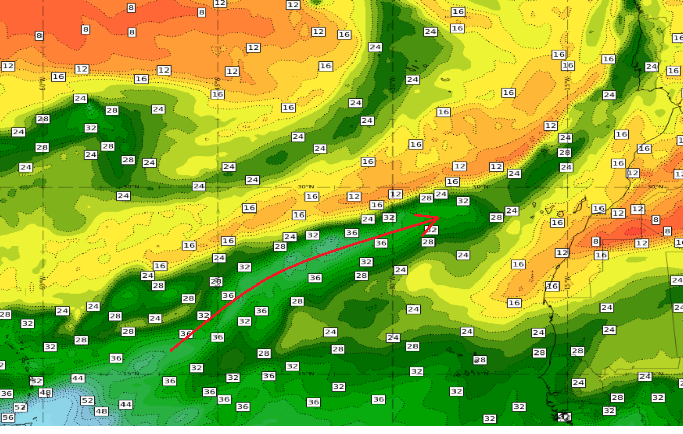
Figure 4: Left: MIMIC-TWP2 product (Microwave humidity sounder composite image), right: ECMWF Total Column Water [mm] from 2 April 2024 at 12:00 UTC. The red arrows depict the same moisture filament in the different projections.
Radiometer instruments are less suited to the detection of ARs, as most of the humidity is in gaseous form accompanied by only a few clouds. Water vapor absorption channels in the infrared spectrum currently do not show these low-level moisture features because of the missing sensitivity of the bands to low-level moisture. Warm water clouds within these moisture filaments show little optical contrast to the sea surface in the infrared image; the visible channels depict them better with the sea acting as a dark background (Figure 5). However, the Dust RGB has some ability to depict low-level moisture gradients in blue colour shades by using the split-window technique [BT10.8 − BT12.9].
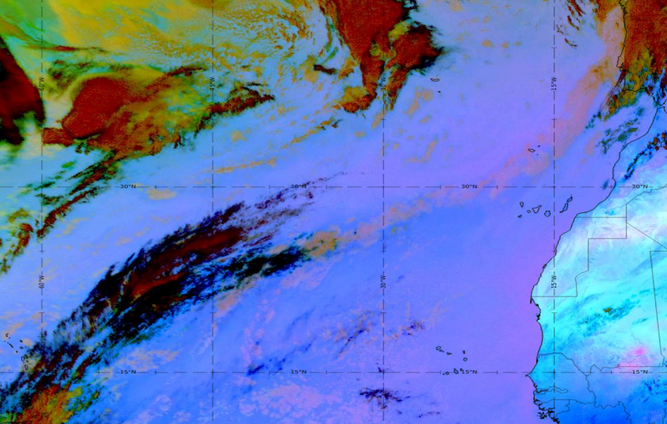
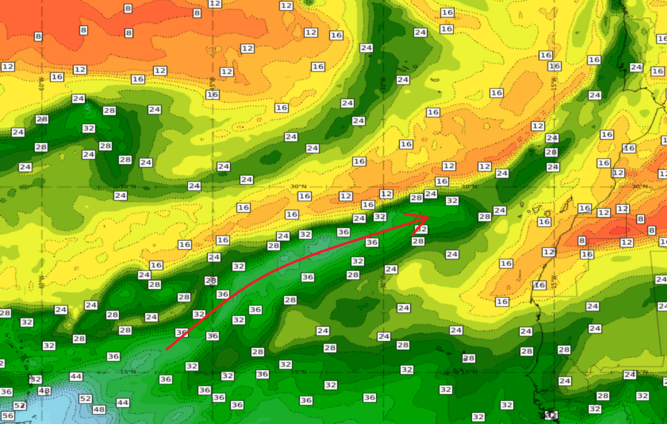
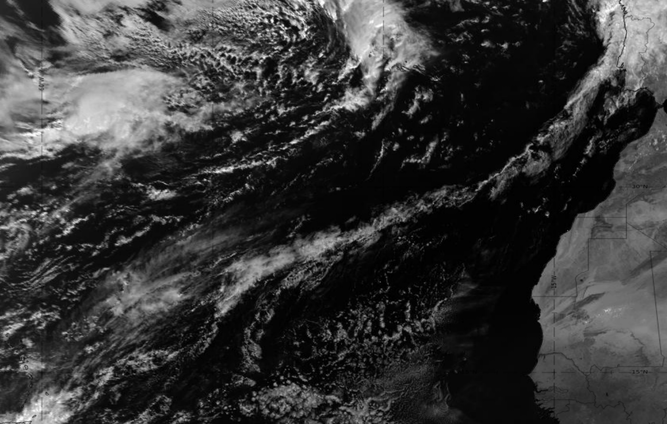
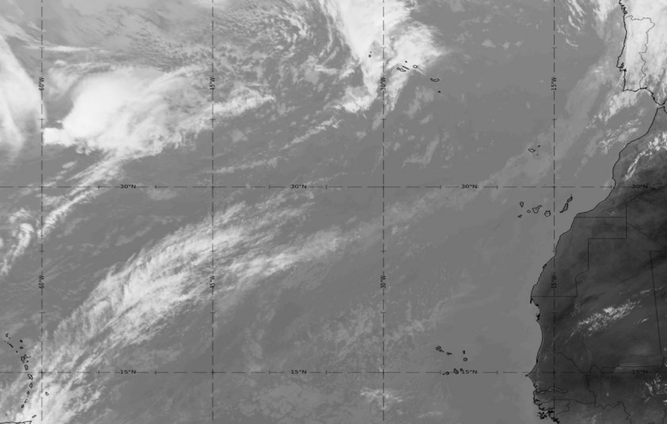
Figure 5: 2 April 2024, 12:00 UTC.
Top: SEVIRI Dust RGB and TCW from ECMWF. The red arrow depicts the moisture filament.
Bottom: VIS 0.8 μm and IR 10.8 μm SEVIRI images.
Once you have identified a moisture filament, it may not necessarily be an Atmospheric River; it could also be:
- a frontal zone (polar- or sub-tropical front)
- an air mass boundary
- an occlusion
- or a moisture convergence zone.
Hence, the next step to follow is to look at the vertical moisture distribution.
Exercise 1:
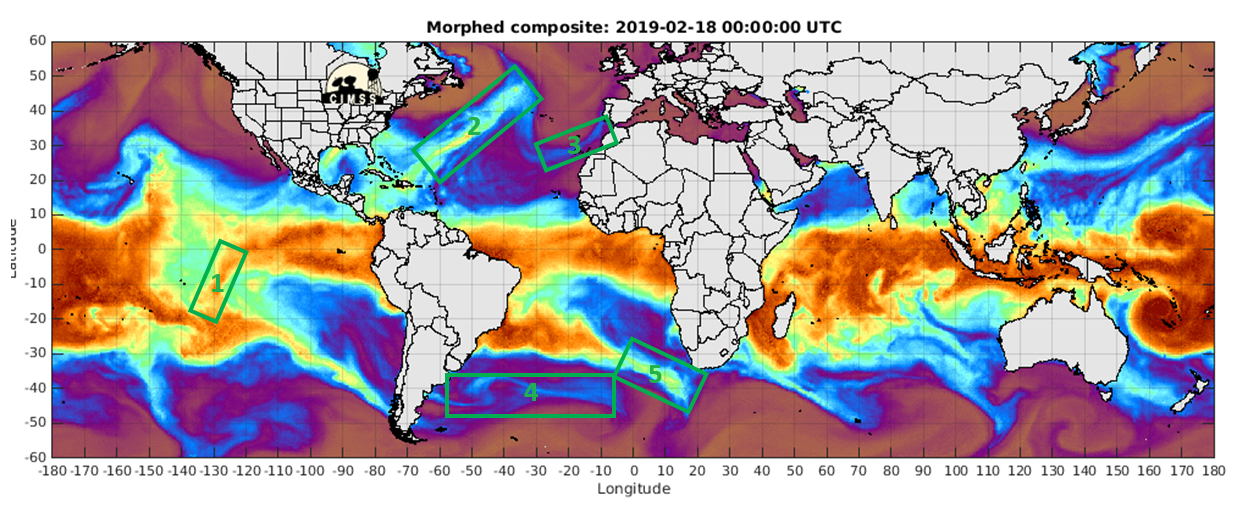
Identify potential candidates for ARs from the microwave satellite data and TCW model field.