False Alarm Ratio (FAR), Post AGreement (PAG) and False alarm rate (F)
|
|
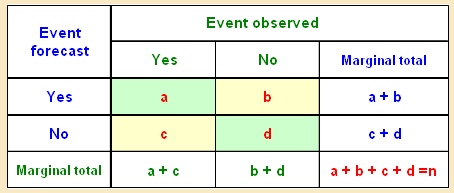
The false alarm ratio is the fraction of the forecasts of the event associated with non-occurrences,
as the name implies and is defined by:
FAR = (false alarms) / (number of forecasts of the event)
The FAR can be controlled by deliberately underforecasting the event; such a strategy risks
increasing the number of missed events, which is not considered in the FAR.
For this reason, the POD and the FAR should both be considered for a better understanding of
the performance of the forecast.
The post-agreement is the complement of the FAR:
PAG = (hits) / (number of forecasts of the event)
The PAG is the fraction of forecasts which were correct, and is not widely used.
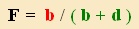
The False alarm rate (F) is given by:
F = (false alarms) / (number of observations of the non-event)
Thus, F is the fraction of non-events which were forecast as false alarms.
The false alarm rate is sometimes called the probability of false detection (POFD).
In that sense, it is akin to false positives on a medical test, or on an X-ray.
Along with the hit rate, the false alarm rate is used in the relative operating
characteristic (ROC) calculations and is related to the Hanssen-Kuipers skill score,
described in the next unit. It is not otherwise widely used.
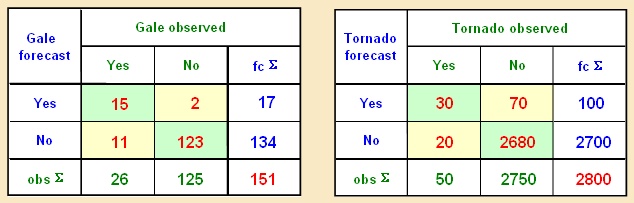
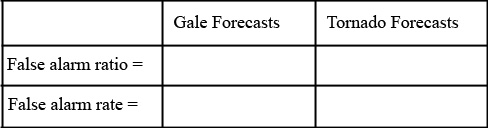
Question: Determine the false alarm ratio and false alarm rate for
the two contingency tables shown above by dragging the correct answer
to the appropriate boxes in the table.
Please put the labels on one of the existing boxes.
You have completed the exercise