 |
| Now that you can classify your favourite weather forecast variable into one of the three types for verification, you are ready to move on to the verification module(s) of your choice. |
Forecast variable types |
|
| Now that you can classify your favourite weather forecast variable into one of the three types for verification, you are ready to move on to the verification module(s) of your choice. |

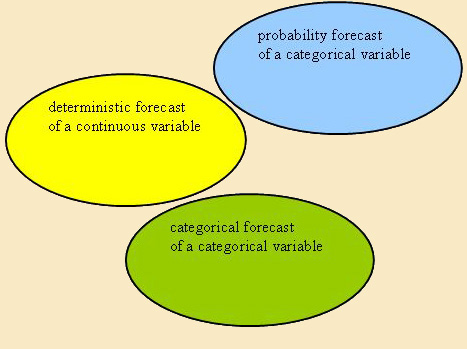
 Wind speed is forecast to be 25 knots Probability of precipitation (POP) =60% overnight Snow is expected tomorrow Today’s maximum temperature is expected to be 6 degrees above normal Rain at times heavy tonight, accumulations greater than 25 mm are expected
Correct. Forecast is for a wind speed of exactly 25 knots.
Correct. Forecast is for a wind speed of exactly 25 knots.
Correct. Forecast is for a wind speed of exactly 25 knots.
Incorrect. Try again.
Incorrect. Try again.
Incorrect. Try again.
Incorrect. Try again.
Incorrect. Try again.
Incorrect. Try again.
Incorrect. Try again.
Incorrect. Try again.
Incorrect. Try again.
Incorrect. Try again.
Incorrect. Try again.
Incorrect. Try again.
Correct. Precipitation occurrence is a dichotomous variable, with the implied threshold at the minimum measureable amount.
Correct. Precipitation occurrence is a dichotomous variable, with the implied threshold at the minimum measureable amount.
Correct. Precipitation occurrence is a dichotomous variable, with the implied threshold at the minimum measureable amount.
Incorrect. Try again.
Incorrect. Try again.
Incorrect. Try again.
Correct. Precipitation type is inherently categorical. No amounts are specified.
Correct. Precipitation type is inherently categorical. No amounts are specified.
Correct. Precipitation type is inherently categorical. No amounts are specified.
Incorrect. Try again.
Incorrect. Try again.
Incorrect. Try again.
Correct. A specific temperature is forecast, but one needs to know what is "normal".
Correct. A specific temperature is forecast, but one needs to know what is "normal".
Correct. A specific temperature is forecast, but one needs to know what is "normal".
Incorrect. Try again.
Incorrect. Try again.
Incorrect. Try again.
Incorrect. Try again.
Incorrect. Try again.
Incorrect. Try again.
Incorrect. Try again.
Incorrect. Try again.
Incorrect. Try again.
Correct. Precipitation accumulation has been expressed as a categorical variable with a threshold.
Correct. Precipitation accumulation has been expressed as a categorical variable with a threshold.
Correct. Precipitation accumulation has been expressed as a categorical variable with a threshold.
Incorrect. Try again.
Incorrect. Try again.
Incorrect. Try again.
Good, this component is correctly located
That is not the correct location !
Please drag the component text labels to their correct position on surface chart.